 TR
TR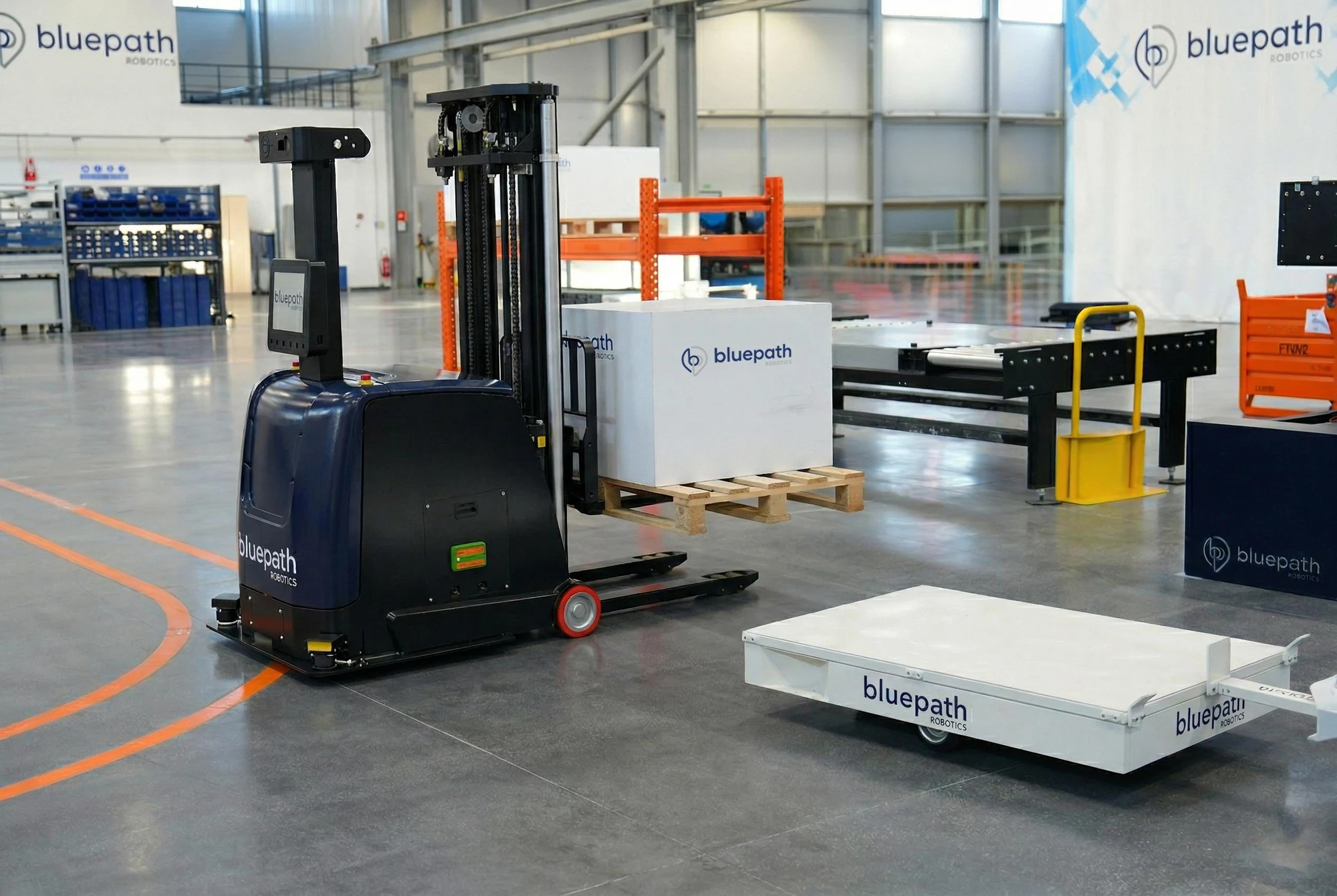
The desire to automate material handling processes in warehouses and production facilities leads businesses to choose between different technologies. Two of the leading options are AMR robots and forklift automation.
Although both technologies aim to move products or materials from one point to another, they differ in terms of usage, load-carrying capacity, maneuvering requirements, and level of automation. For this reason, there is no single answer that applies to every business when asking, “Is an AMR autonomous mobile robot or a forklift better?”
The right choice depends on the nature of the load, lifting height, task frequency, warehouse layout, shared working conditions with employees and the company’s growth plans. In fact, in some facilities, the most efficient solution may be a hybrid automation model in which AMR and forklift technologies are used together.
What Is an AMR Robot?
An AMR robot is a mobile robot system that can move autonomously by perceiving its environment. AMRs can determine their location and create a route suitable for the defined destination by using data obtained from laser scanners, lidar, cameras, encoders, and other sensors.
AMR robots are generally used in the following applications:
- Transporting crates, pallets, and boxes
- Transferring shelves or transport carts
- Feeding production lines
- Moving parts between assembly stations
- Sending products from picking areas to packaging points
- Transporting light or medium-weight pallets
- Transferring empty packaging and waste
Depending on the intended use, an AMR can be equipped with a lift module, conveyor, shelf-carrying attachment, towing system, or robotic arm. In this way, the same mobile platform can be configured for different logistics tasks.
What Is Forklift Automation?
Forklift automation refers to the automatic operation of forklift-type vehicles that can lift, lower, stack, or transport palletized loads. These vehicles may also be referred to as autonomous forklifts, driverless forklifts, or robotic forklifts.
Automated forklifts do not only perform horizontal transport. With the right model and system design, they can pick up a pallet from the floor, place it on a rack, or retrieve it from a specified height.
Main areas of use include:
- Placing pallets onto racks
- Retrieving pallets from racks
- Transfers between goods receiving and shipping areas
- Transporting pallets between production and warehouse areas
- Collecting finished products from the end of the line
- Block stacking
- Transferring pallets to conveyors
The safe use of manual forklifts requires operator training, site rules, and proper vehicle selection. Occupational safety resources draw attention to risks such as tipping, pedestrian collisions, falling loads, limited visibility, and loading ramps.
Key Differences Between AMR and Autonomous Forklift
When comparing AMR and forklift automation, in a product like Bluepath Robotics’ CounterBalance Forklift, it is not enough to consider only the vehicle’s mobility. The way the load is picked up and dropped off must also be evaluated.
| Comparison Criteria | AMR Robot | Autonomous Forklift |
|---|---|---|
| Main task | Horizontal material transport | Transport, lifting, and stacking |
| Typical load | Crates, boxes, shelves, carts, or pallets | Mainly palletized loads |
| Lifting height | May be limited depending on the top module | Suitable for racking operations |
| Maneuvering area | Generally more compact | May require more space due to the load and fork structure |
| Load transfer | May require a station or attachment | Can pick up loads directly with forks |
| Flexibility | Suitable for task and route changes | Specialized in pallet processes |
| Integration | WMS, ERP, MES, WCS | WMS, WCS, rack and pallet systems |
| Main use | Line feeding and transport between stations | Pallet pickup, drop-off, and stacking |
The features in the table represent a general comparison. Actual performance varies depending on the technical capacity of the selected model and site conditions.
Navigation and Route Flexibility
Modern AMR robots can adapt to dynamic environments with digital mapping and autonomous navigation capabilities. They can calculate routes within predefined safe zones and adjust their speed or path according to the obstacles they encounter.
Advanced navigation technologies can also be used in autonomous forklifts. However, the load carried by the forklift can affect the field of view and safe stopping distance. In addition, the position of the forks, pallet stability, and turning radius must be considered during route planning.
Therefore, in a narrow-aisle facility, the following issues should first be analyzed:
- The total dimensions of the vehicle with the load
- Turning radius
- Safe stopping distance
- Pedestrian traffic
- Two-way vehicle passage
- Blind spots
- Rack and column positions
Load Type and Lifting Requirement
One of the most decisive criteria when choosing between an AMR and a forklift is whether the load only needs to be transported or also lifted.
If a product needs to be picked up from a ground-level station and taken to another station, an AMR may be more suitable. For example, sending part crates to a production line or moving picking carts to a packaging area are typical AMR AGV tasks.
On the other hand, if a pallet needs to be placed into high rack locations, a forklift-type automation solution may be more functional. The forked system can directly pick up the pallet and lift it to the appropriate level.
Still, a forklift is not always required for pallet transport. If the load will only move at floor level or between standard transfer stations, an AMR with a lifting module can also be considered.
Warehouse Layout and Space Utilization
Forklifts need a certain maneuvering area to lift the pallet, approach the station for docking, and turn. Insufficient aisle width may limit the mobility of an automated forklift.
Compact AMR robots, on the other hand, can operate in narrower spaces for some horizontal transport tasks. Especially AMR models that move under the load or tow a transport cart can be used without making major changes to the existing layout.
However, a narrow aisle does not always mean that it is suitable for an AMR. The safety zone around the robot, sensor visibility, load overhang, and escape distances must be considered. For a sound selection, it is useful to conduct a simulation or field test based on the facility layout.
Comparison in Terms of Operational Safety
In AMR AGV and autonomous forklift projects, safety is not limited to the number of sensors listed in the product catalog. The entire life cycle of the robot within the site must be evaluated.
ISO 3691-4:2023 addresses the safety requirements of driverless industrial truck systems, including AMRs and AGVs. The scope of the standard includes not only the vehicle itself but also elements such as the control system, guidance tools, and preparation of the operating zone.
The following risks should be evaluated in the project:
- Pedestrians and robots using the same aisle
- Load falling or shifting
- Pinch points in narrow areas
- Ramps and floor slopes
- Encounters with manual forklifts
- Emergency stop scenarios
- Charging areas
- Communication interruptions
- Stopping and docking distance with heavy loads
Autonomous systems may reduce some risks caused by human error, but they can also introduce new system-related risks. Therefore, site risk analysis, commissioning tests, and employee training are indispensable.
Capacity and Transport Performance
Forklift automation generally stands out in transporting heavy pallets and performing racking operations. AMR robots, on the other hand, can offer advantages in carrying out many short-distance, frequently repeated transport tasks in parallel.
When evaluating performance, the maximum speed of the robot should not be the only criterion. The truly important indicators are:
- Number of completed tasks per hour
- Load pickup and drop-off time
- Average route length
- Waiting time in traffic
- Downtime caused by charging
- Service capacity of stations
- Task distribution within the fleet
- Queues during peak hours
If a faster vehicle is constantly waiting in front of a station, it may not deliver the expected efficiency. In other words, simply having a faster autonomous mobile robot does not improve the process. An autonomous mobile robot that can work in harmony with other variables can achieve this. Therefore, the entire process should be analyzed from end to end.
Software and System Integration
For AMRs and autonomous forklifts to operate effectively, they must communicate with the company’s digital systems. While the WMS warehouse management system determines which pallet or material will be transported, the fleet management system can assign the task to the appropriate vehicle.
The following components can be evaluated within the scope of integration:
- WMS and ERP systems
- Production planning software
- Barcode and RFID infrastructure
- Automatic doors
- Conveyors
- Elevators
- Production line belts
- Rack and pallet sensors
- Fleet traffic management, etc.
When multiple robots are used, fleet management becomes more important. The system should prevent vehicles from accumulating at the same passage point, distribute tasks according to capacity, and manage the charging plan without disrupting operations.
How Should Investment Cost Be Compared?
Comparing only the vehicle purchase price can be misleading. The following items should be included in the total investment evaluation:
- Robot or automated forklift cost
- Add-ons such as top modules and conveyors
- Software licenses
- WMS, ERP, or MES integration
- Charging stations
- Wireless network improvements
- Site arrangements
- Safety equipment
- Operator and maintenance training
- Periodic maintenance
- Spare parts and batteries
- Future capacity increase
Return on investment should be calculated based on business-specific data such as the current workforce structure, number of shifts, task volume, cost of errors, and system availability. It would not be accurate to provide a fixed payback period that applies to every business.
In Which Cases Can an Autonomous Mobile Robot Be Preferred?
An AMR robot can be a strong option under the following conditions:
- Most loads are transported on a horizontal, smooth surface
- Crates, pallets, baskets, shelves, or transport carts dollies are used
- Task points change over time
- Many short-distance transports are performed
- Production stations need to be fed regularly
- A compact and scalable fleet is targeted
- New robots are planned to be added to transport tasks
- A safer working environment can be created by reducing accident risks
In Which Cases Can Forklift Automation Be Preferred?
A Forklift AMR like CounterBalance Forklift may be more suitable for the following needs:
- Pallets need to be placed on high racks
- The load needs to be picked up directly from the floor
- Heavy pallets are handled
- Block stacking is performed
- Standard tasks exist between goods receiving and pallet storage
- The existing operation mainly depends on forklift processes
Can AMR and Forklift Be Used Together?
In many facilities, the right answer may not be AMR or forklift, but AMR and forklift.
For example, an autonomous forklift can pick up a pallet from the goods receiving area and leave it at an intermediate transfer station. An AMR robot, such as a towing or lifting type, can then carry this pallet to the point of use on the production line. In another scenario, AMRs can bring small materials to picking stations while forklifts manage pallet movements on racks.
In a hybrid model, tasks are distributed according to the strengths of each vehicle:
- Forklift: lifting, stacking, and heavy pallet transport
- AMR: frequently repeated horizontal transport and station feeding
- Conveyor: high-volume flow on a fixed line
- Manual vehicle: low-frequency, occasional, or non-standard tasks
This approach can create a more balanced automation structure instead of trying to adapt the entire operation to a single technology.
Conclusion: The Right Technology Is Determined by the Right Process
When comparing AMR and forklift automation, the vehicle’s price or maximum speed should not be the only decision criterion. AMR robots stand out in flexible route management, compact design, and horizontal transport tasks, while autonomous forklifts provide significant advantages in pallet lifting and racking operations.
To determine the right solution for your business, classify your current transport tasks, analyze load characteristics, measure hourly task volume, and evaluate site risks. Then compare AMR, autonomous forklift, or hybrid fleet alternatives based on total cost of ownership.
A properly designed AMR AGV autonomous mobile robot and forklift automation system can make internal warehouse material flow more measurable, safer, and more scalable.


