
 TR
Autonomous Mobile Robot Guide
AGV vs AMR Robots: Which Technology Leads the Smart Factories of the Future?
As Industry 4.0 continues to accelerate, companies are adopting next-generation automation systems to improve efficiency across manufacturing and logistics operations. At the center of this transformation are AMR, AGV, and autonomous mobile robot technologies.
One important question remains for many organizations: should you choose an AMR robot or an AGV robot?
Key takeaways
The short answer, before the detail.
01
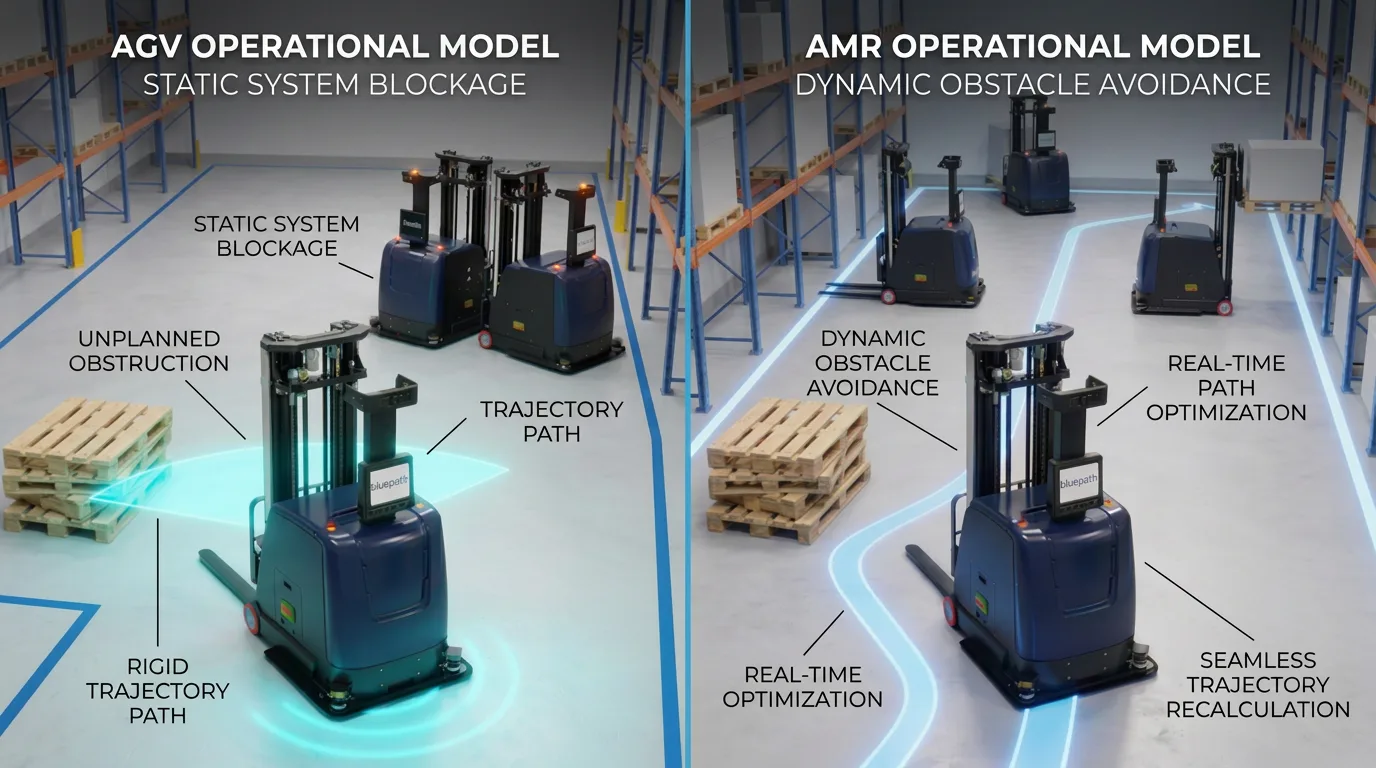
AGVs follow a predefined route set by magnetic tape, QR codes, reflectors or floor patterns. AMRs build their own route from a live map.
02
When an obstacle blocks the path, most AGVs stop and wait for operator intervention. An AMR analyses the obstacle and drives around it.
03
AGV technology is not obsolete. It remains strong on fixed lines, repetitive routes, heavy loads and low-variability operations.
04
Many companies achieve ROI on AMR projects within 12 to 24 months, and faster in high-volume manufacturing environments.
Section 01
What Is an AGV Robot?
An AGV (Automated Guided Vehicle) is a driverless transport system that moves along a predefined route. These robots have been used for decades across industries such as automotive manufacturing, home appliances and heavy industry.
AGV robots typically navigate by following
Magnetic tapes installed on the floor
QR codes
Reflectors
Guide paths and floor patterns
Advantages of AGV Robots
- Stable and predictable movement
- Low operational error rates
- High efficiency in fixed production lines
- Safe transportation of heavy loads
- Proven, reliable technology with a long track record
Disadvantages of AGV Robots
The biggest limitation of AGV systems is their lack of flexibility.
- Adding a new route may require infrastructure modifications or changes within the facility.
- The system must often be reprogrammed when production lines change.
- If an obstacle blocks the route, many AGVs stop and wait for operator intervention.
For this reason, AGV systems may be less effective in highly dynamic, constantly changing environments.
Section 02
What Is an AMR Robot?
An AMR (Autonomous Mobile Robot) is an intelligent robotic system capable of perceiving its surroundings and creating its own route using dynamic mapping technology. These technologies allow AMRs to map their environment and optimize their movements in real time, so an AMR does not require any physical guidance infrastructure to navigate.
01
Lidar sensors
02
3D cameras
03
Artificial intelligence algorithms
04
SLAM natural navigation
Simultaneous Localization and Mapping
How Does Autonomous Mobile Robot Technology Work?
An autonomous mobile robot continuously scans and analyses its operating environment. For example, an AMR travelling through a warehouse will:
- Detect its surroundings using onboard sensors.
- Determine its position on a digital map.
- Calculate its destination.
- Generate the safest and shortest route.
- Analyse obstacles encountered along the way.
- Select an alternative path when necessary.
This enables operations to continue without interruption. Many of the inefficiencies commonly associated with traditional AGV systems can be eliminated through AMR technology.
Section 03
Key Differences Between AGV and AMR Robots
An AGV repeats a route defined in advance. An AMR generates the safest and shortest route from a live map, then re-plans as conditions change.
AGV guidance is physically installed in the facility. AMRs navigate with Lidar, 3D cameras and SLAM, so nothing is added to the floor.
A blocked aisle halts most AGVs until an operator intervenes. An AMR analyses the obstacle and selects an alternative path, so the operation continues.
Changing an AGV route can mean infrastructure work and reprogramming. AMR routes are changed in software.
Without floor guidance to install and commission, AMR deployments reach production faster.
Select a row for context. When comparing these technologies, it becomes clear that AMR systems offer significant advantages, particularly in manufacturing and warehouse environments that frequently change.
Section 04
Return on Investment of AMR and AGV Solutions
One of the most important considerations for any business is return on investment. Many companies achieve ROI from AMR projects within 12 to 24 months, and in high-volume manufacturing environments the payback period can be even shorter.
12–24
Months to ROI
Typical payback window on a well-planned mobile robot project.
24/7
Continuous operation
AMR-based automation keeps warehouse operations running around the clock.
0
Added infrastructure
No magnetic tape, QR codes or markers required to deploy an AMR fleet.
Reduced labour costs
Increased production capacity
Lower error rates
Improved material flow
Greater operational visibility
Section 05
The Importance of AMR Robots in Smart Factories
Many manufacturers are transitioning toward the smart factory concept. AMR robots are among the most important technologies supporting all of its primary goals.
Smart factory goals
- Reducing human errors
- Increasing production efficiency
- Optimizing material flow
- Lowering operational costs
- Collecting real-time data
AMR tasks on the plant floor
- Raw material transportation
- Work-in-progress material transfer
- Production line replenishment
- Pallet transportation
- Automated warehouse operations
Section 06
AMR Robots in Warehouse and Logistics Operations
As the e-commerce industry continues to expand, warehouse efficiency has become increasingly important. An increasing number of logistics centres are investing in AMR technology.
Common warehouse challenges
- Long walking distances
- Operator inefficiencies
- Order fulfilment errors
- Traffic congestion
With AMR-based automation
- Picking times are reduced
- Order accuracy improves
- Workplace safety increases
- Operations can continue 24/7
Section 07
Which System Is the Better Choice?
When Is an AGV System the Better Choice?
AGV technology has not become obsolete and remains a powerful solution in specific applications. AGVs are often the preferred option for:
- Fixed production lines
- Repetitive transportation routes
- Heavy-load handling
- Low-variability operations
The right solution varies depending on the operational requirements of each business.
When Is an AMR System the Better Choice?
Because these industries frequently experience operational changes, the flexibility of AMR technology provides a significant advantage.
- Automotive manufacturing
- Electronics production
- Home appliance manufacturing
- Pharmaceutical operations
- E-commerce warehouses
- Third-party logistics (3PL) centres
- Rapidly growing production facilities
Section 08
The Role of Mobile Robots in the Factories of the Future
In today’s increasingly competitive global market, companies are adopting production models that are more agile, efficient and sustainable. Within this transformation, AMR, AGV and autonomous mobile robot solutions have become an essential part of digital transformation strategies.
In the near future, fleets of mobile robots working alongside human employees are expected to become standard across manufacturing facilities, warehouses and logistics centres. Supported by AI-powered navigation systems and advanced sensor technologies, these robots will continue to become smarter, safer and more efficient.
Conclusion
AGV and AMR technologies represent two key pillars of industrial automation. However, in today’s dynamic manufacturing and logistics environments, AMR robots are increasingly becoming the preferred choice due to their flexibility, autonomous navigation capabilities and scalability.
If your business is planning warehouse automation, intralogistics optimization or a smart factory transformation, selecting the right AMR, AGV or autonomous mobile robot solution can provide a significant competitive advantage. With the right mobile robot technology, you can accelerate operations, reduce costs and take your Industry 4.0 transformation to the next level.
Section 09
Frequently Asked Questions
What is the main difference between an AGV and an AMR robot?
An AGV (Automated Guided Vehicle) moves along a predefined route set by magnetic tape, QR codes, reflectors or floor patterns. An AMR (Autonomous Mobile Robot) perceives its surroundings and creates its own route using dynamic mapping, so it needs no physical guidance infrastructure.
What happens when an obstacle blocks the path?
If an obstacle blocks the route, many AGVs stop and wait for operator intervention. An AMR analyses the obstacle and selects an alternative path when necessary, allowing operations to continue without interruption.
How does autonomous mobile robot technology work?
An autonomous mobile robot continuously scans its operating environment. It detects its surroundings using onboard sensors, determines its position on a digital map, calculates its destination, generates the safest and shortest route, analyses obstacles along the way and selects an alternative path when necessary.
Does an AMR need magnetic tape or QR codes?
No. AMR robots use Lidar sensors, 3D cameras, artificial intelligence algorithms and SLAM natural navigation to map their environment and optimize their movements in real time, so no additional infrastructure is required.
Is AGV technology obsolete?
No. AGV technology remains a powerful solution for fixed production lines, repetitive transportation routes, heavy-load handling applications and low-variability operations. The right solution varies depending on the operational requirements of each business.
Which industries benefit most from AMR robots?
AMR robots are particularly well suited to automotive manufacturing, electronics production, home appliance manufacturing, pharmaceutical operations, e-commerce warehouses, third-party logistics (3PL) centres and rapidly growing production facilities.
What is the return on investment for an AMR project?
Many companies achieve ROI from AMR projects within 12 to 24 months, and in high-volume manufacturing environments the payback period can be even shorter. A well-planned mobile robot project reduces labour costs, increases production capacity, lowers error rates, improves material flow and increases operational visibility.
Does Bluepath Robotics produce AMRs or AGVs?
Bluepath Robotics produces state-of-the-art AMR products, but all of our product range is configurable to work as AGVs. If your facility needs guided vehicles, all of our products can be provided as AGVs — so the exact answer depends on your needs.
AMR by design, AGV on request
We build AMRs. Every one can run as an AGV.
Autonomous navigation is what we engineer for: our robots map their own routes, re-plan around obstacles, and need nothing added to your floor. Fixed guidance still earns its place on stable, repetitive lines, so every product in our range can be configured to run as an AGV instead. Tell us how your facility runs.

